The Axial Stone Circles
02.08.2026
I had arrived in an area of south west Ireland with a rich assortment of megalithic sites known as Axial Stone Circles. They usually have around thirteen to nineteen stones, with a flat stone usually positioned south westerly and with two portal stones opposite. Ahead of me was the Beara Peninsula and these circles were common all the way down.
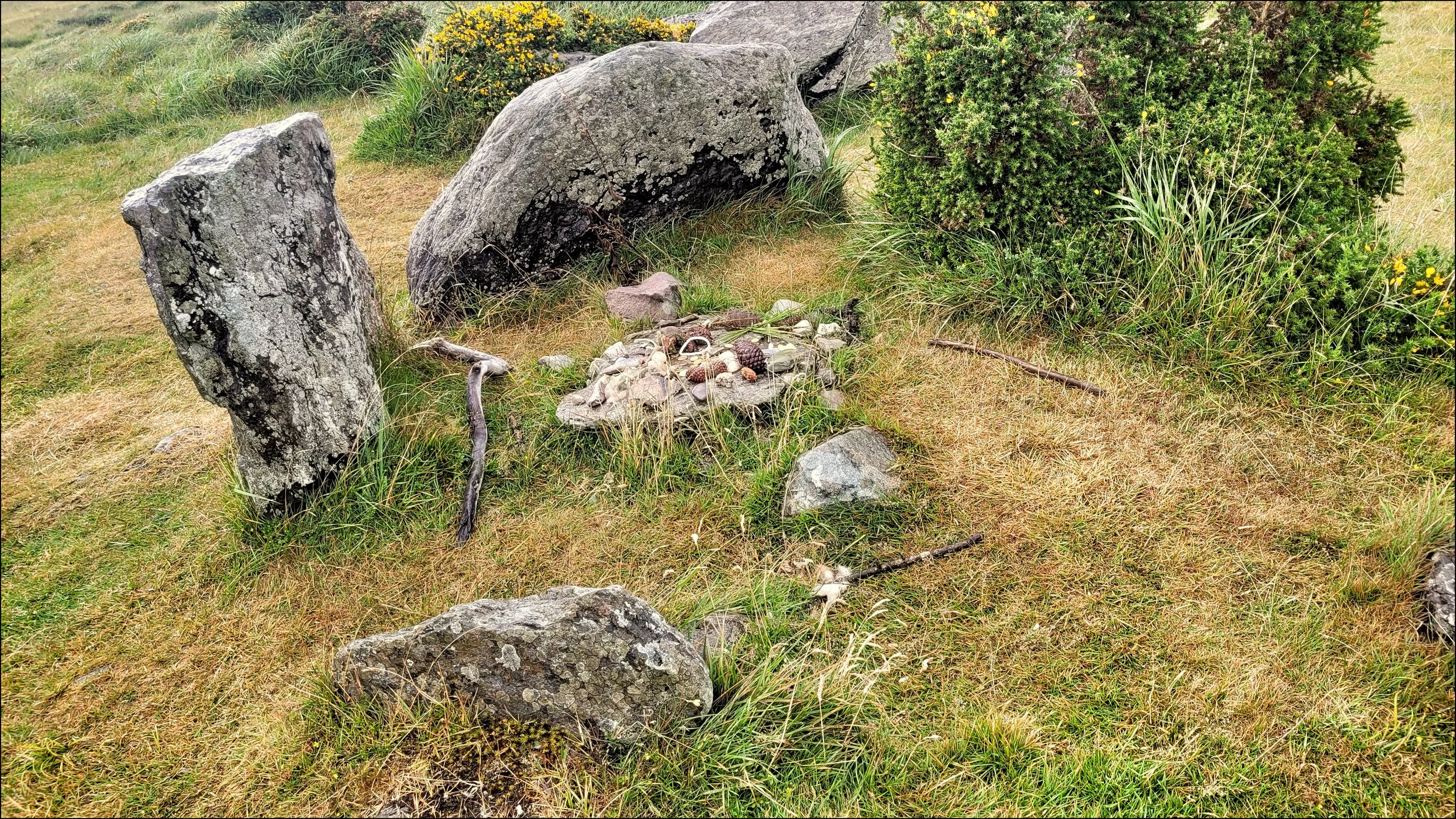
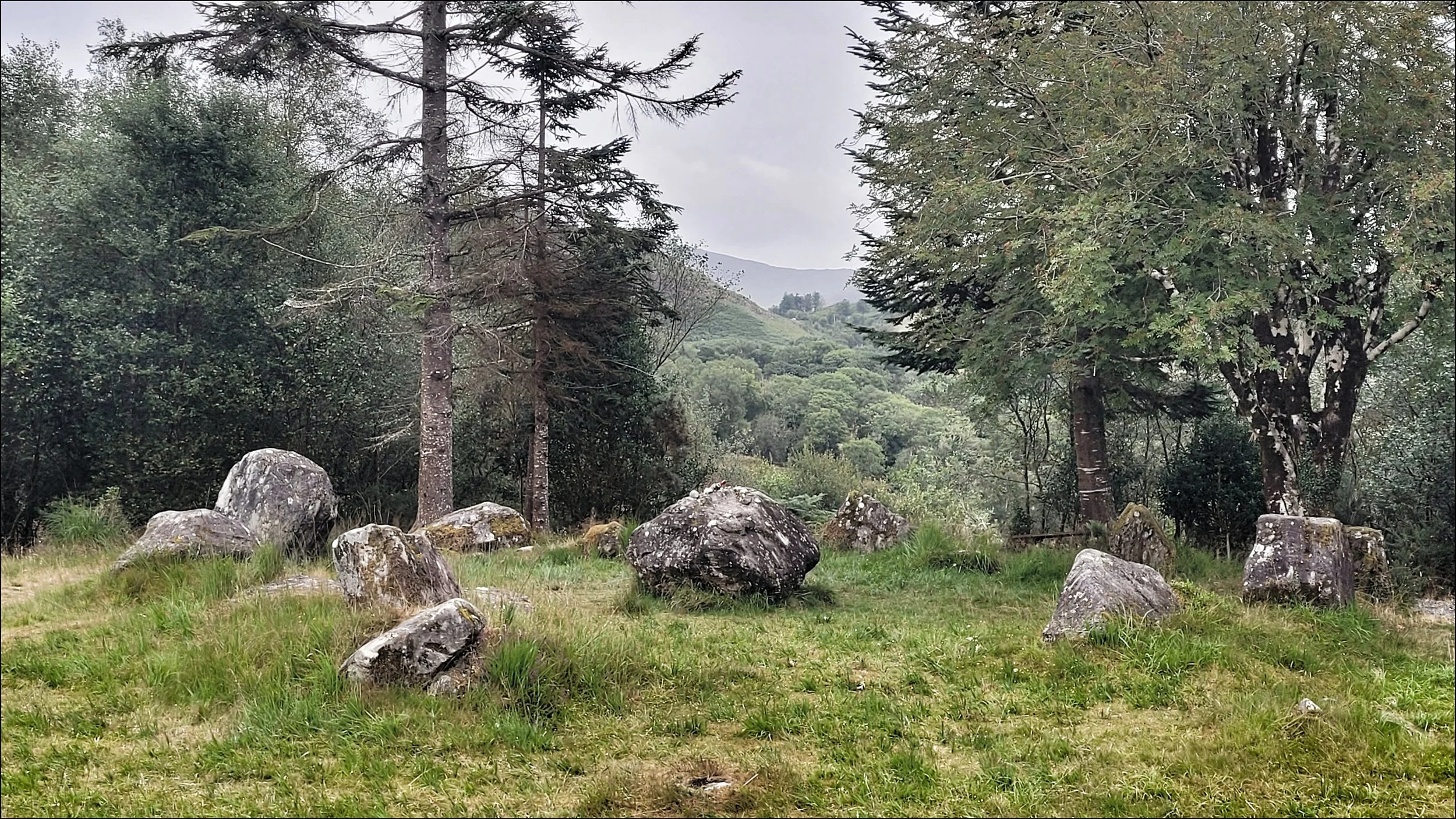
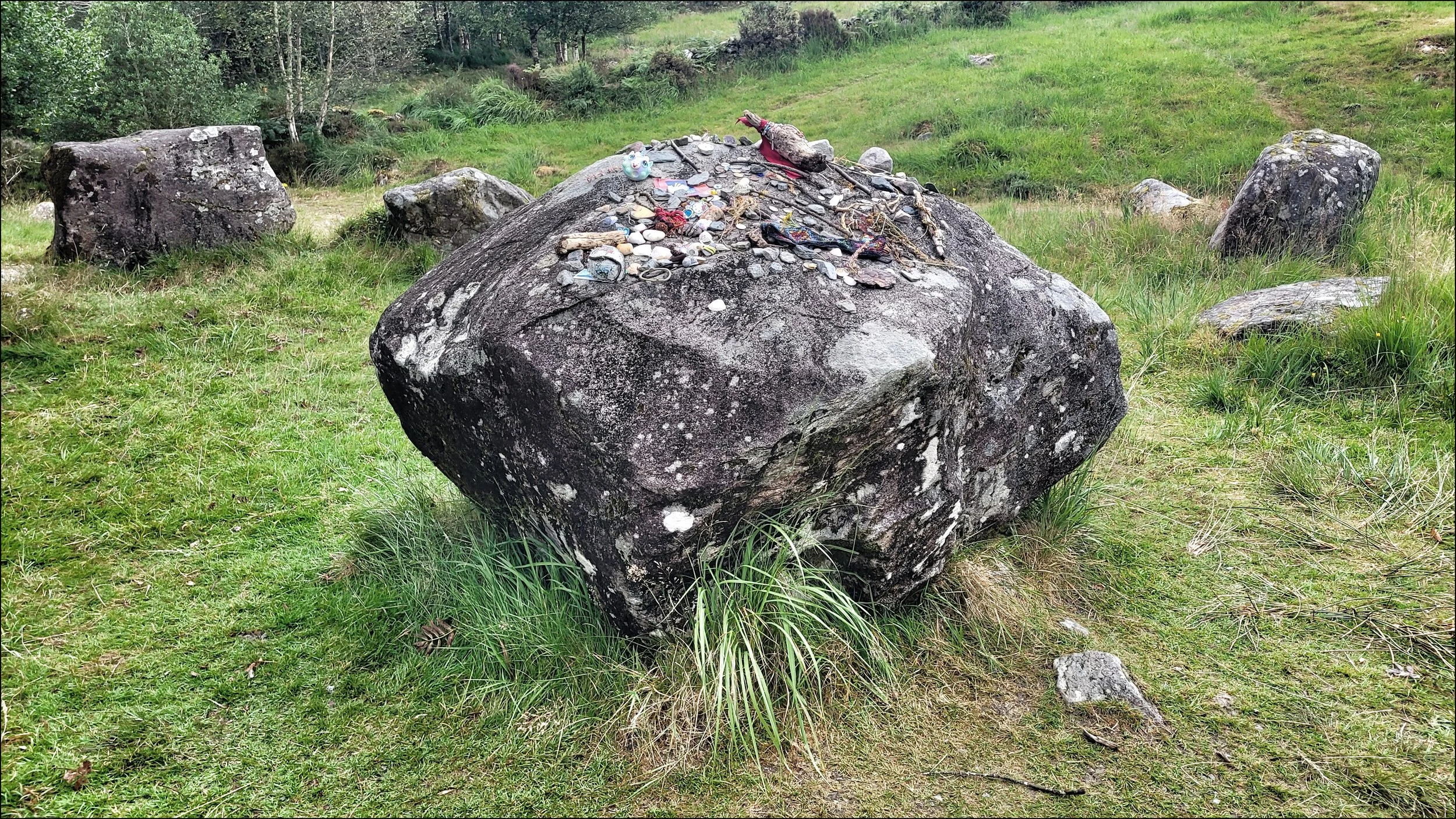
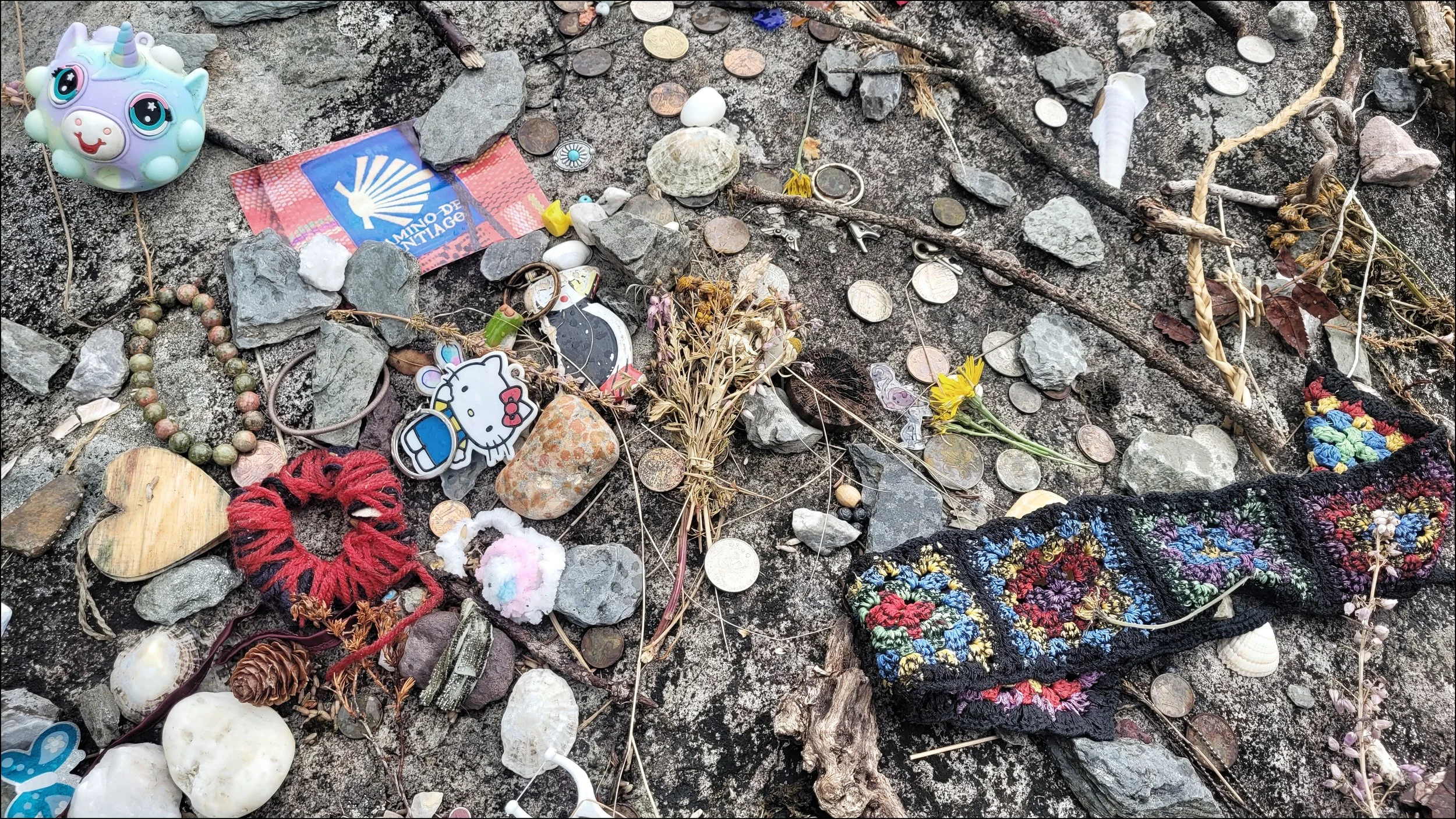
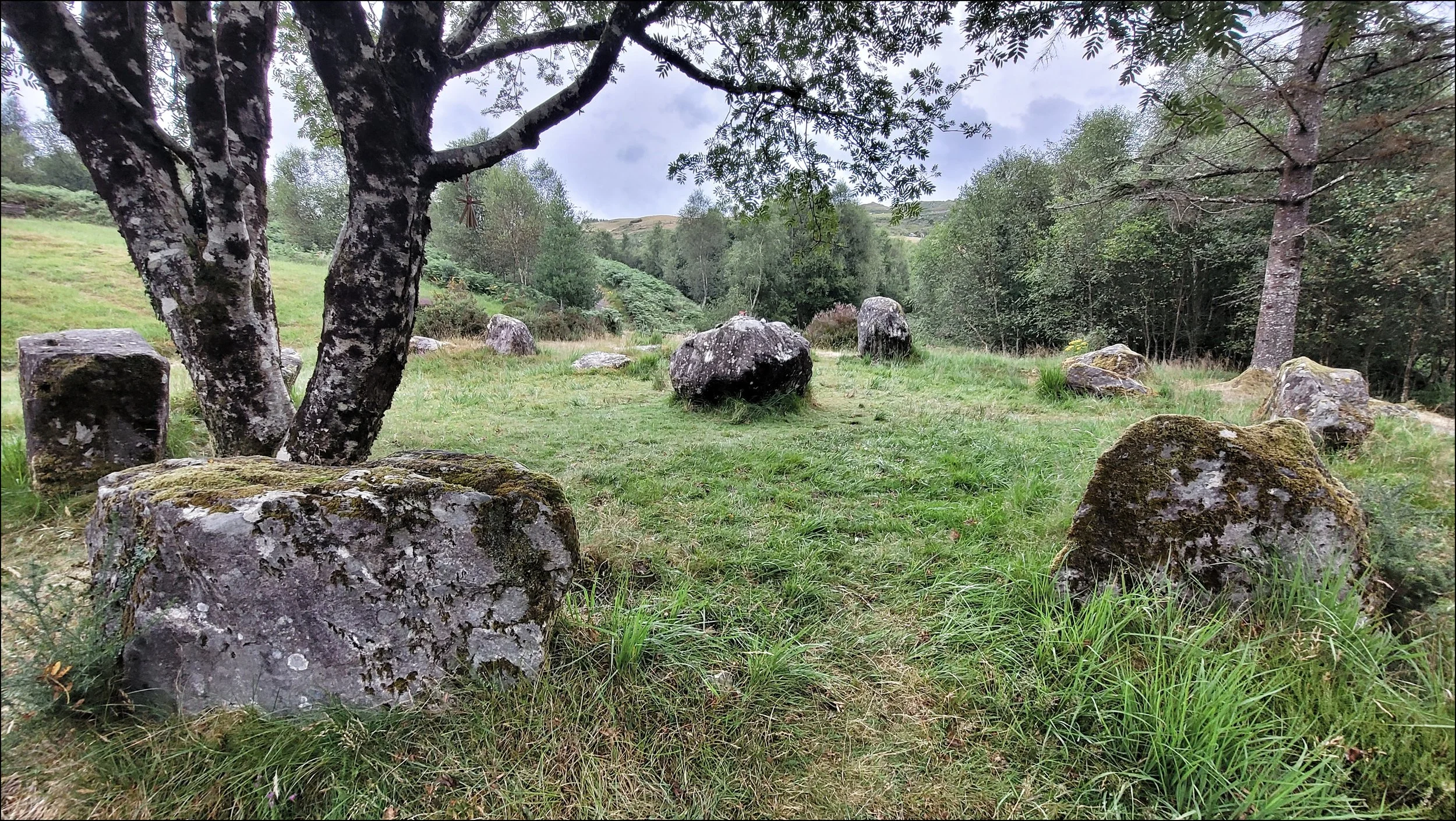
The first of these was Dromagorteen, sited in the Bonane Heritage Park on an hour long looped trail. It sits in a forest clearing and is made up of thirteen stones from a possible seventeen, and like Kenmare it has a boulder burial stone at it's centre. Here, the Axial Stone and two portal stones align with the summer solstice sunrise, while every eighteen and a half years the lunar standstill occurs where the moon appears to climb the ridge of a distant hill to the south east. The large burial boulder at the centre had an assortment of offerings placed on it including bones, bracelets and coins, along with a few plastic toys. I had never seen a stone with as many tributes on it. Just inside the circle near the Axial Stone was a mature Rowan tree, where a corn dolly hung from a low branch. I followed the trail around past an ancient cooking pit known as a Fulacht Fiadh and a Bullaun Stone with a bowl like groove cut out of it’s sloping face, possibly intended for ritual offerings.
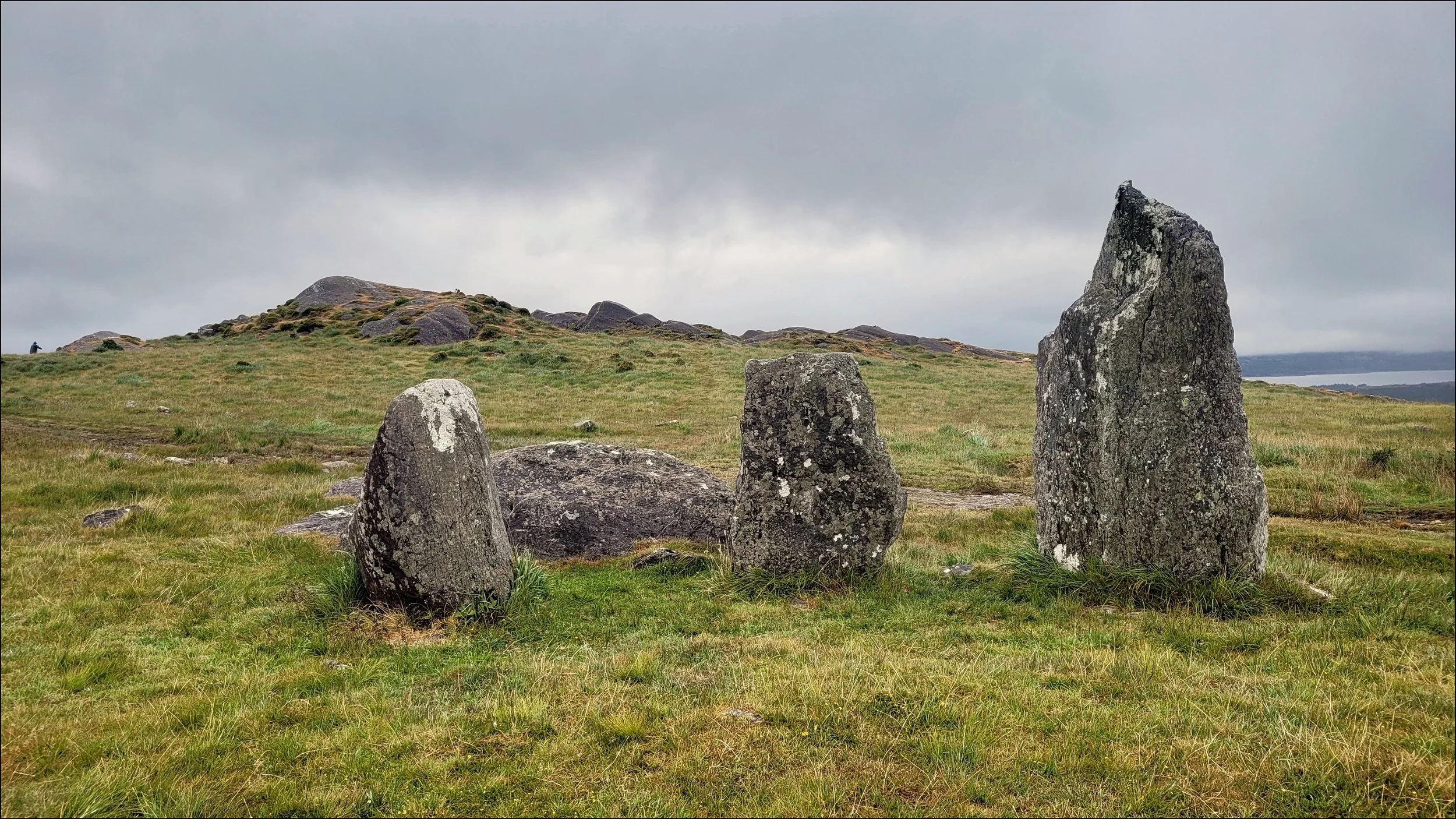
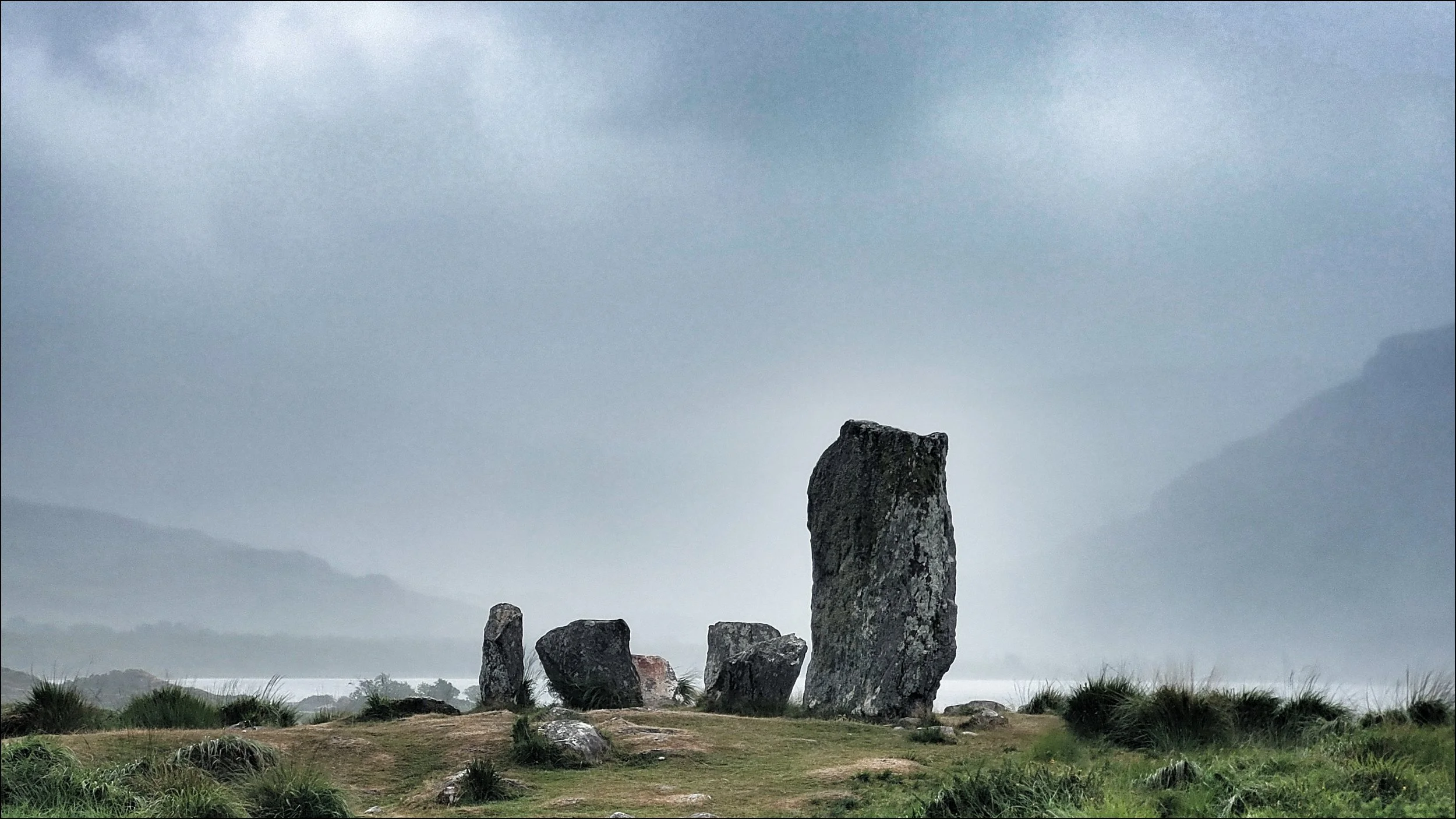
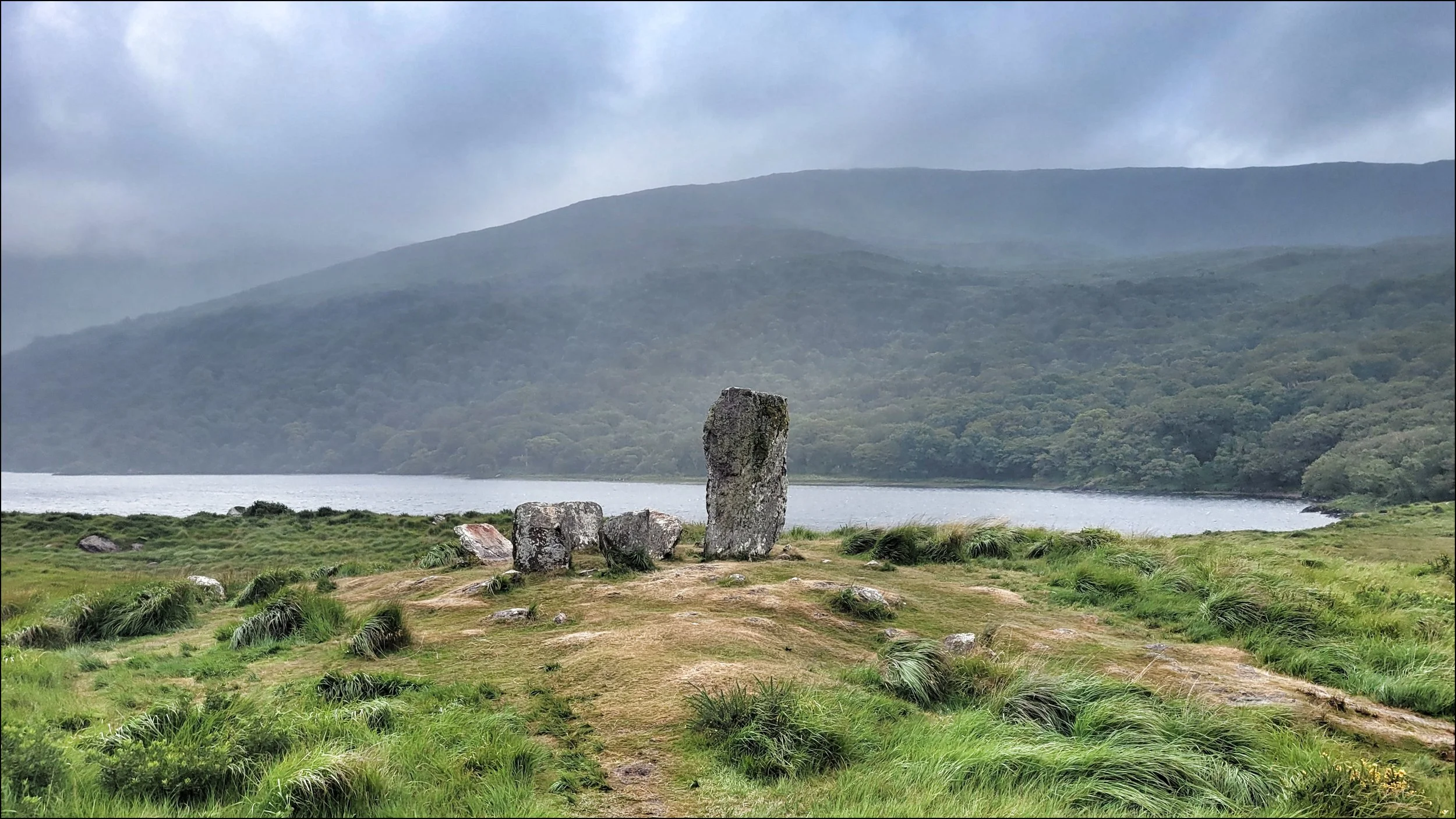
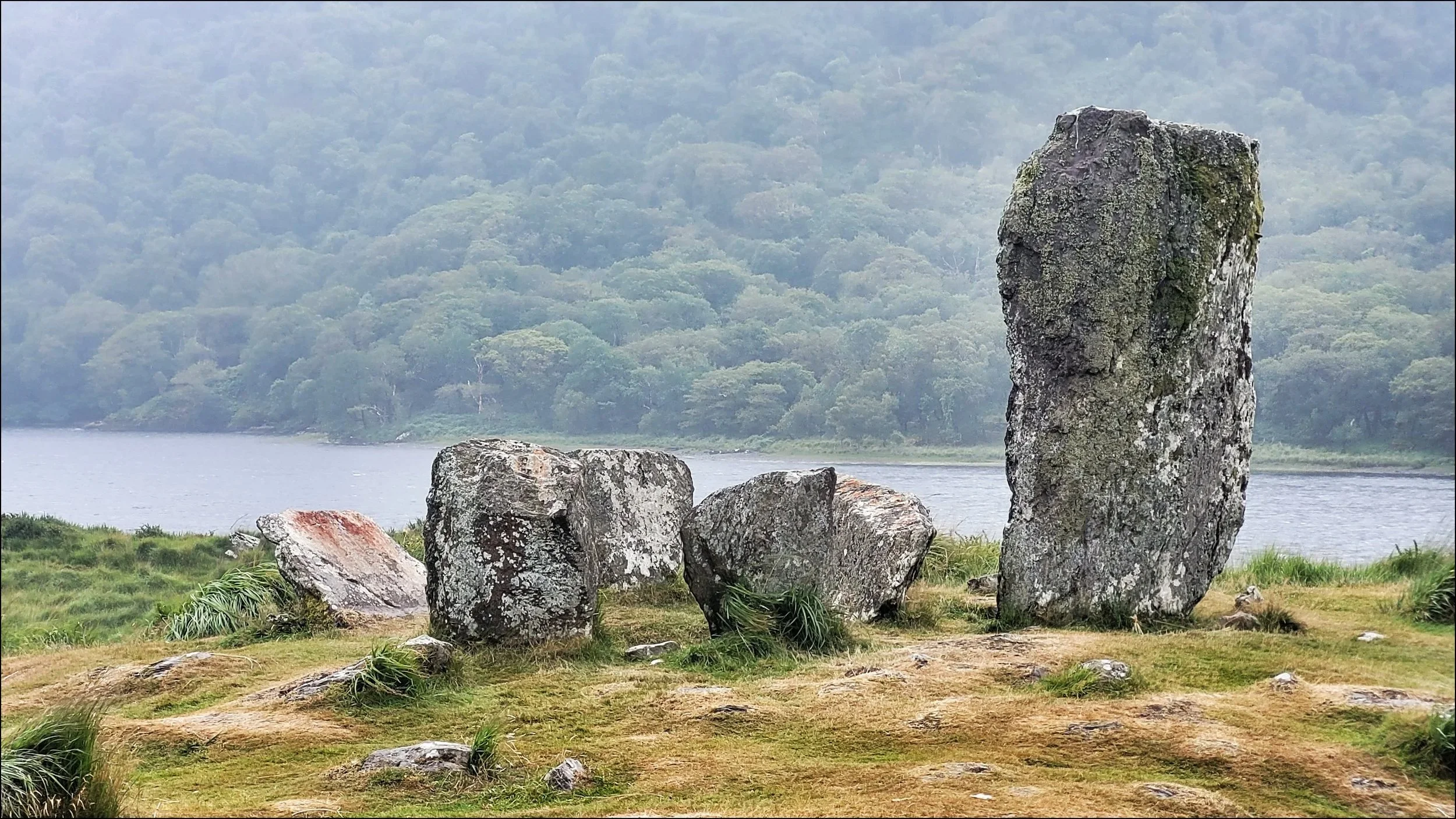
Twenty five kilometers down the Beara Peninsula is an area of Kerry that feels very remote. On high ground between Lough Inchiquin and Lough Cloonie is Uragh Stone Circle with one of the best approaches to a site I can remember. It came into view as I climbed up to the ridge, taking centre stage with a U shaped glacial valley behind it disappearing off to the south east.
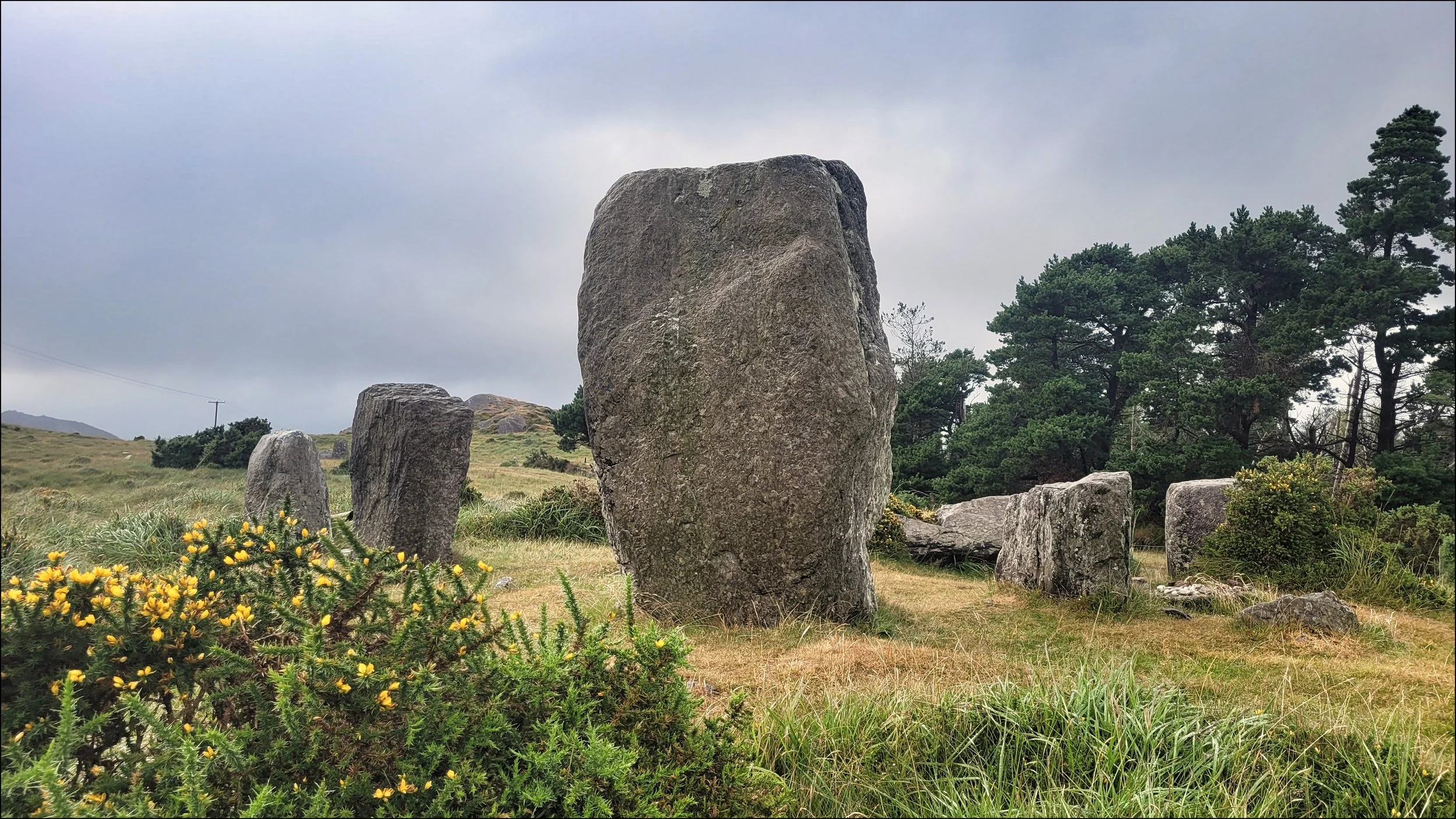
A choral soundtrack played in my head as I got closer to this compact crown like structure of six stones, with five making up the circle and a three metre giant next to it standing guard like a sentinel. At the centre of the circle lay a cist, now just a depression in the ground. Here too were offerings and another corn dolly lay at the base of the Axial Stone. Further out around the perimeter of the crown were possible small kerbstones and two larger fallen uprights, one of which may have been a portal stone.
I sat down on one of the stones to take in the unforgettable three sixty degree views of dense forests lining the Loughs and their tiny islands. As the sun occasionally broke through the mist, so did the the choral music in my head. Undoubtedly, this must have been a place that had conjured ritual and emotion for the creators of Uragh.
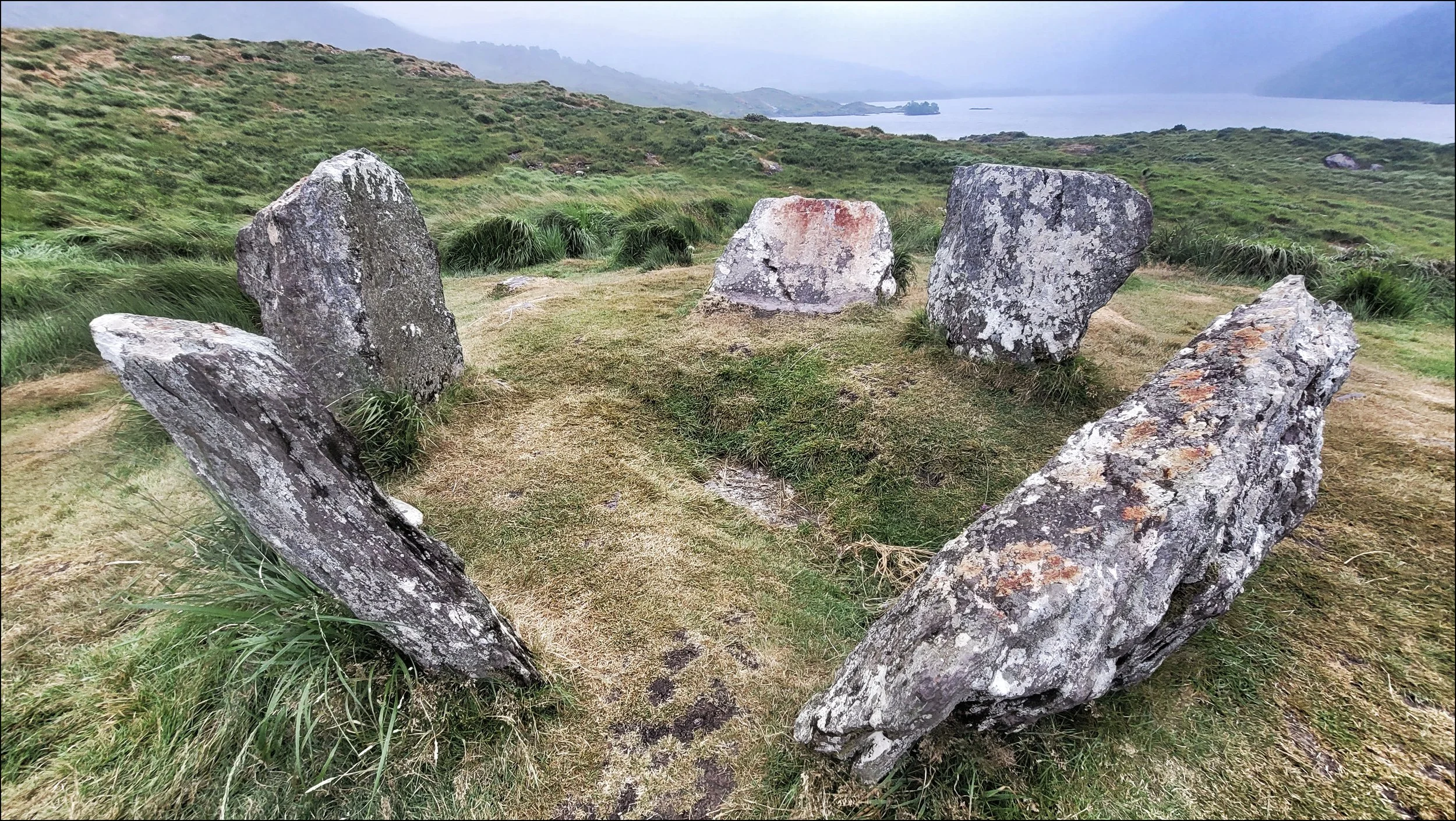
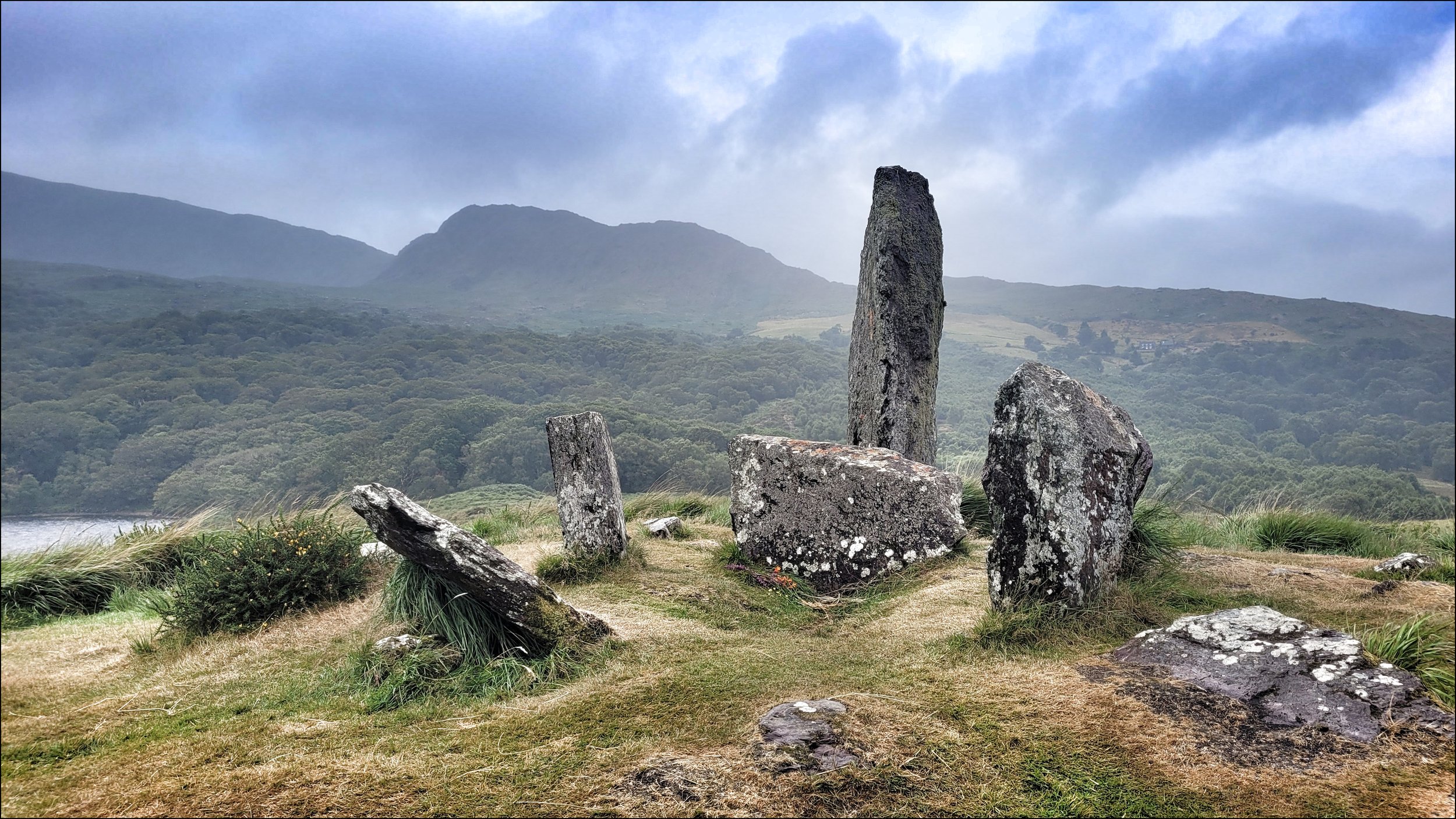
I now had a bit of a challenge on my hands as I reached another remote part of the Beara. The Drombohilly Stone Circle was up on a plateau of waterlogged rough pasture. I had found a pull in on a narrow lane in the shadow of Knockatee Mountain. As I walked back along the road I could just see the circle in a clearing of pine trees, but there looked to be no easy route up to it. A farm track through a series of gates was easy enough, but the going got tough after a barbed wire fence where the fern covered ground became sodden and very uneven. With the addition of thick gorse It was difficult to see where to place my feet and every other step plunged me ankle deep in water. In situations like this I had got into the habit of thinking of other past quests where I had been close to turning round and giving up. I would pose the question ‘‘Who in their right mind would put up with this ?’’ to which I would always reply, ‘‘Well me of course !’’
My perseverance paid off and I had the circle in my sights after a long arduous hour. I knew as soon as I made it to the first of the stones this circle had had few visitors. Despite the dense ground cover the nine Stones stood out well, but with a diameter of over eight metres it took a lot of effort to find my way around it. The ambience here was strange. I would normally have classed this as a hostile setting, but the circle gave off a very positive energy. Despite being drenched through from the waste down, I felt a calming aura emanating out from the centre.
Unlike the other Axial circles I'd seen so far, here the stones were taller and more pointed. The taller portal stones were head height with one of them leaning sideways toward the other. How different this place was to the manicured setting of Kenmare and it's daily round of sightseers.
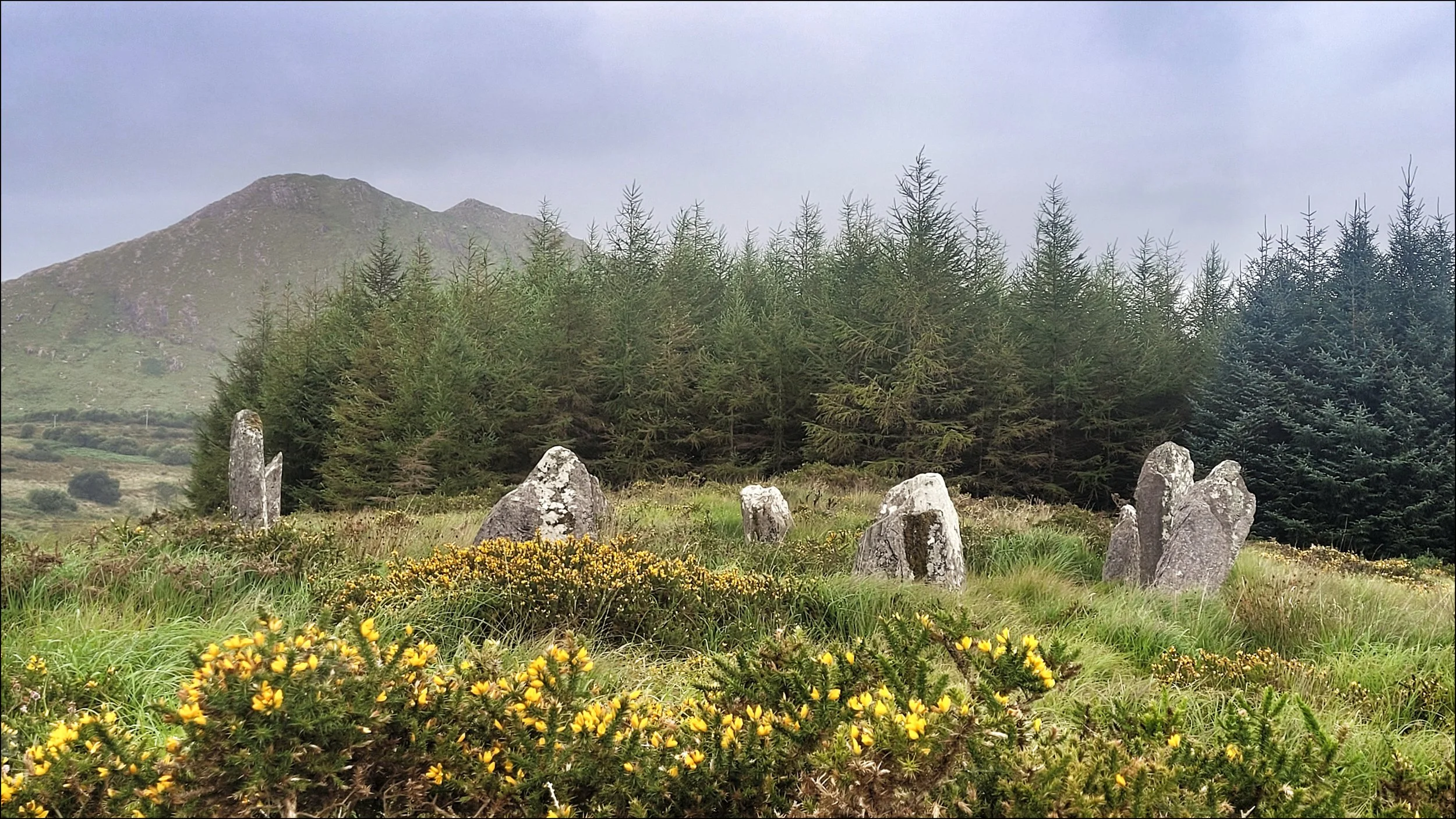
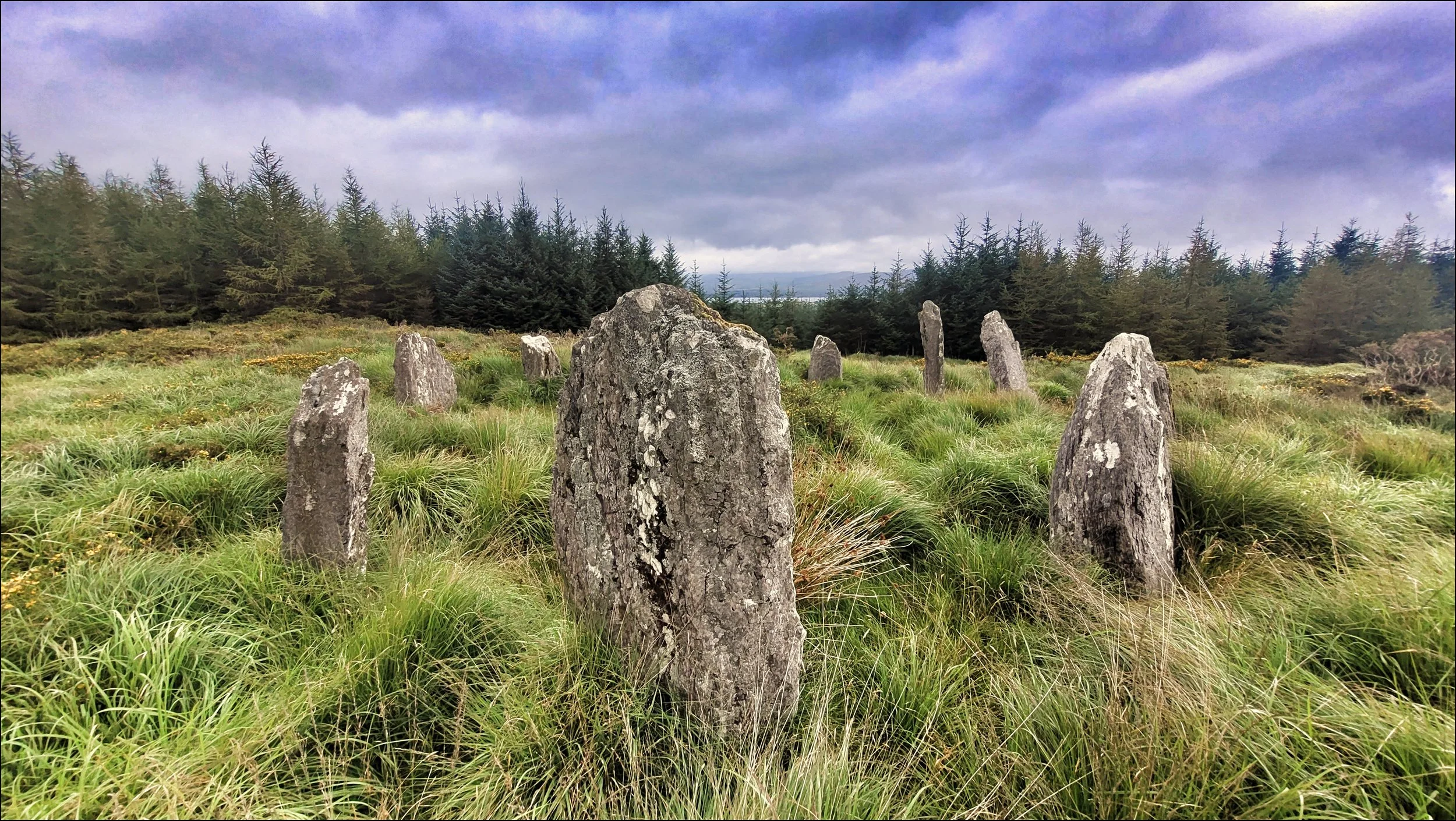
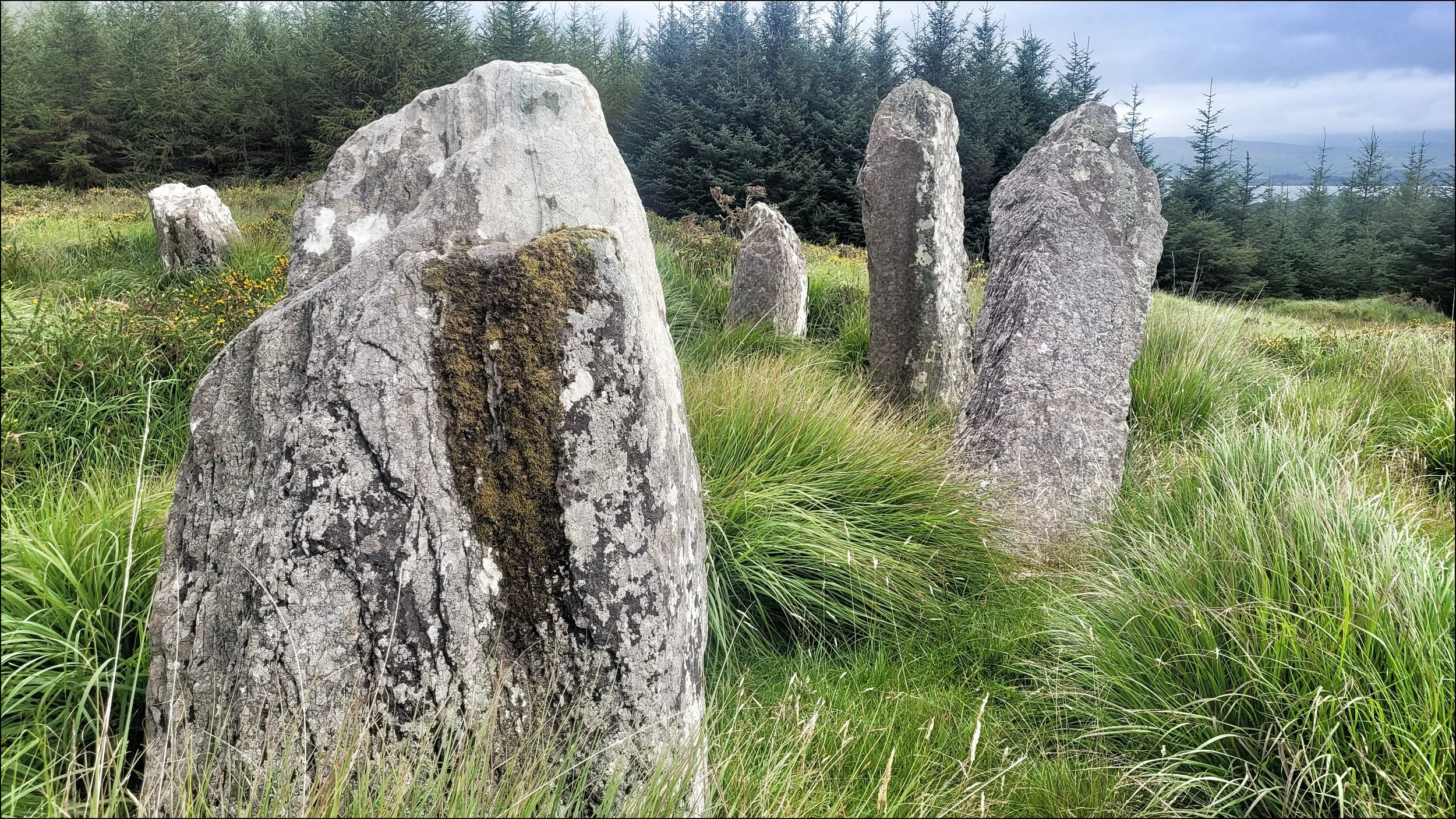
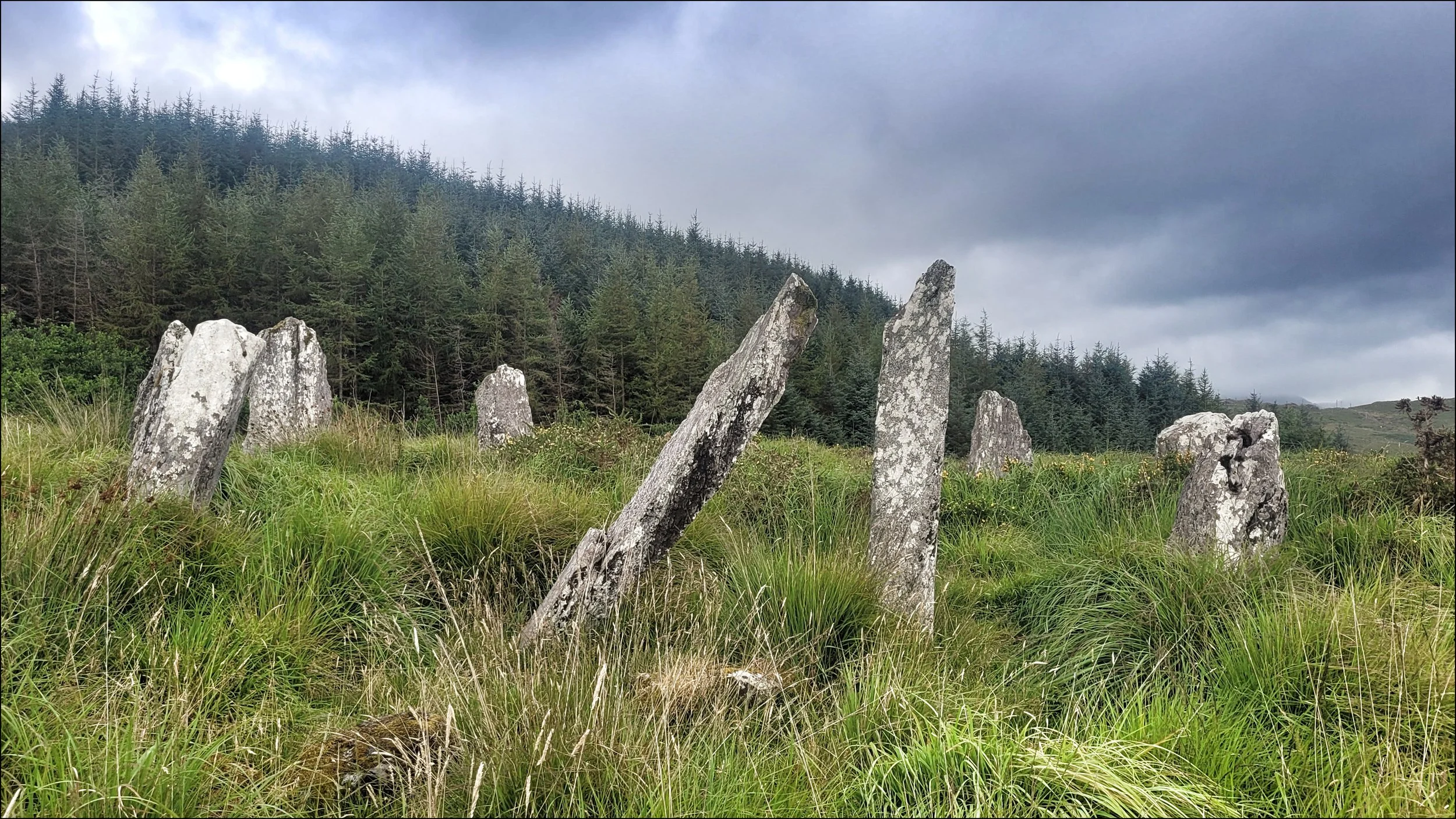
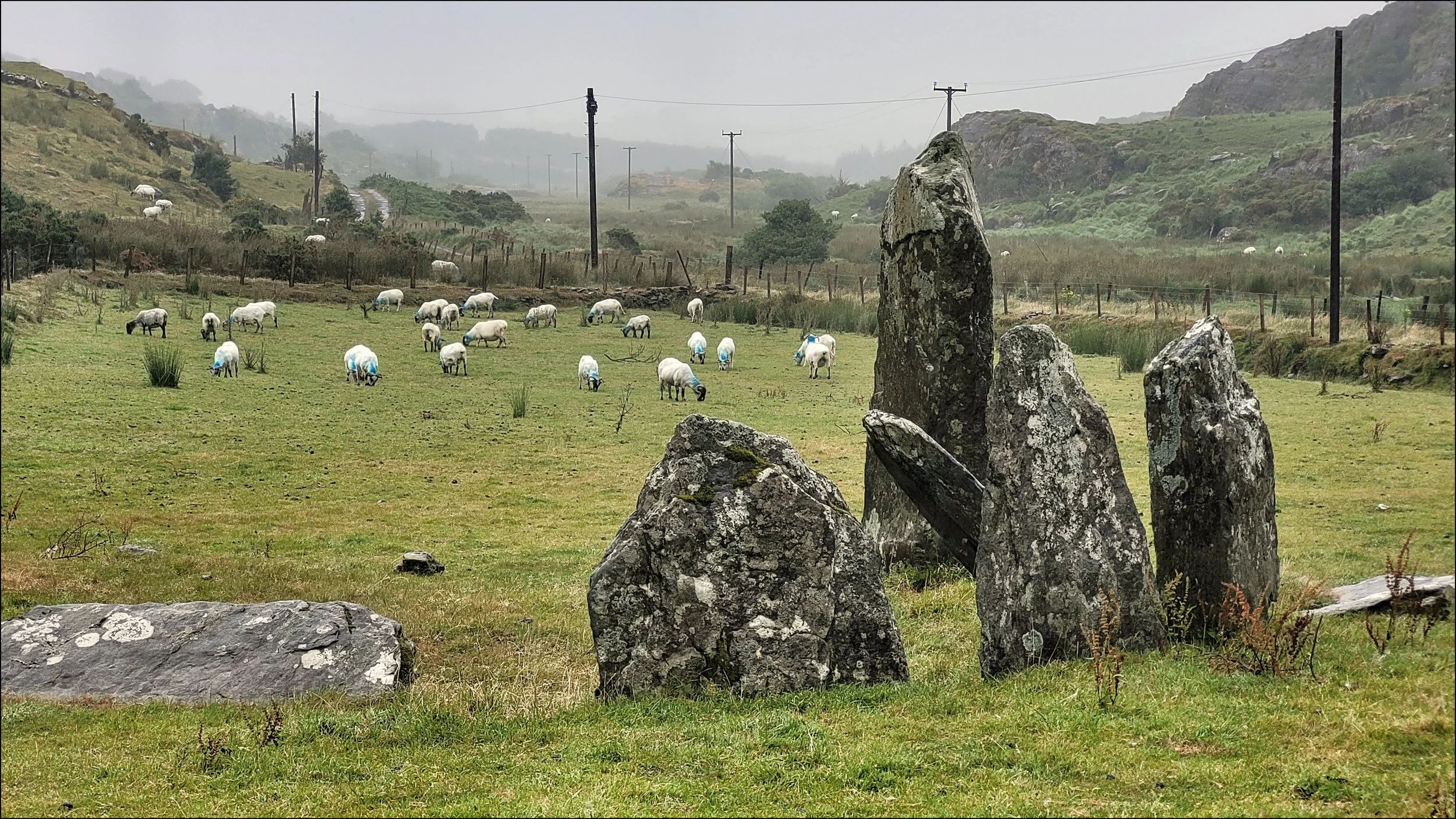
I drove on through Derreen and then along the River Drunminboy all the way to a farm at the end of a dead end road. Either side were the peaks of Tooth Mountain and Lockabane with the border of County Cork just over the head of the valley. Near to the river in a field beside a farmhouse is Shronebirrane, a circle similar in diameter to Drombohilly. This viewing was a different proposition with easy access and the very welcoming sight of short grass, courtesy of the sheep.
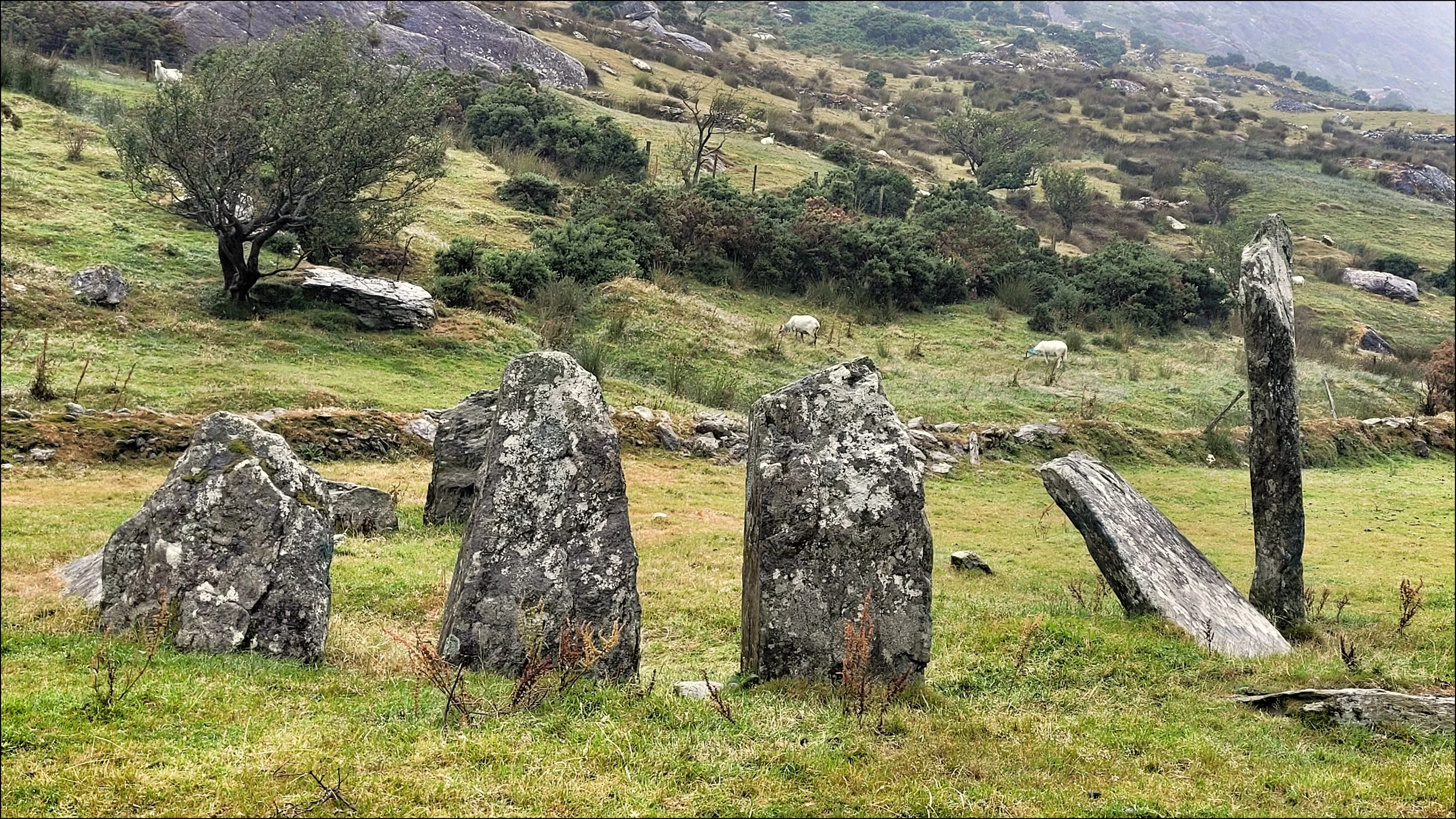
I waited for the rain to ease, popped a few euros into the donation box and headed over to find eight stones of variable height all leaning in to each other. The northern side of the arc had a conspicuous gap, and so judging by the close arrangement of stones on the eastern side, it looked like there may have been more than the estimated original thirteen. One of the portal stones had been pilfered, most likely for building, with the recumbent opposite being low to the ground. Two large fallen stones lay in close proximity to where they once stood. Like at Drombohilly, there was no evidence of a central cist.
I stood there for a while as the rain came down again tuning into the silence and felt, despite the few houses here, I was at the very heart of Ireland's wild west.
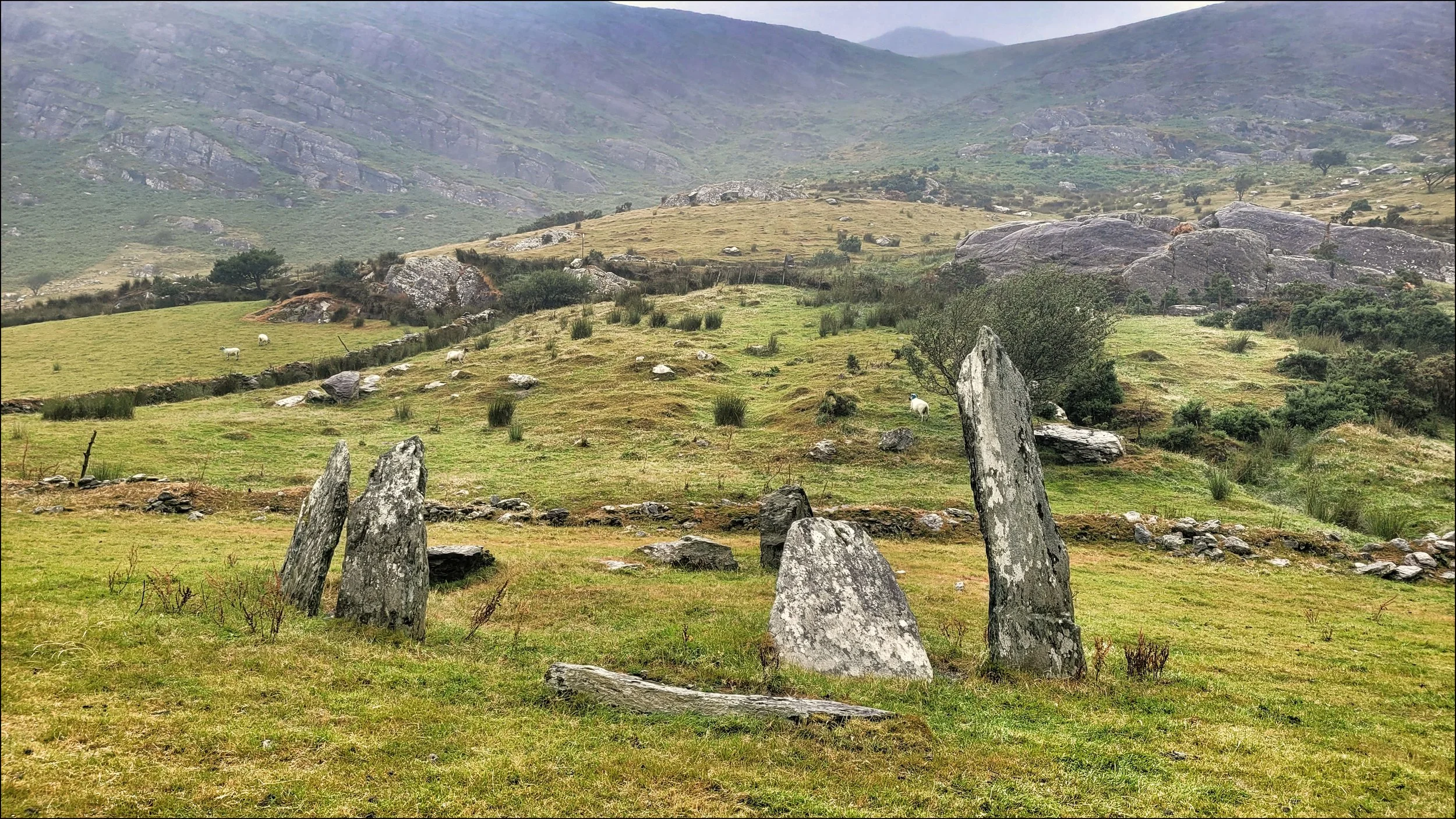
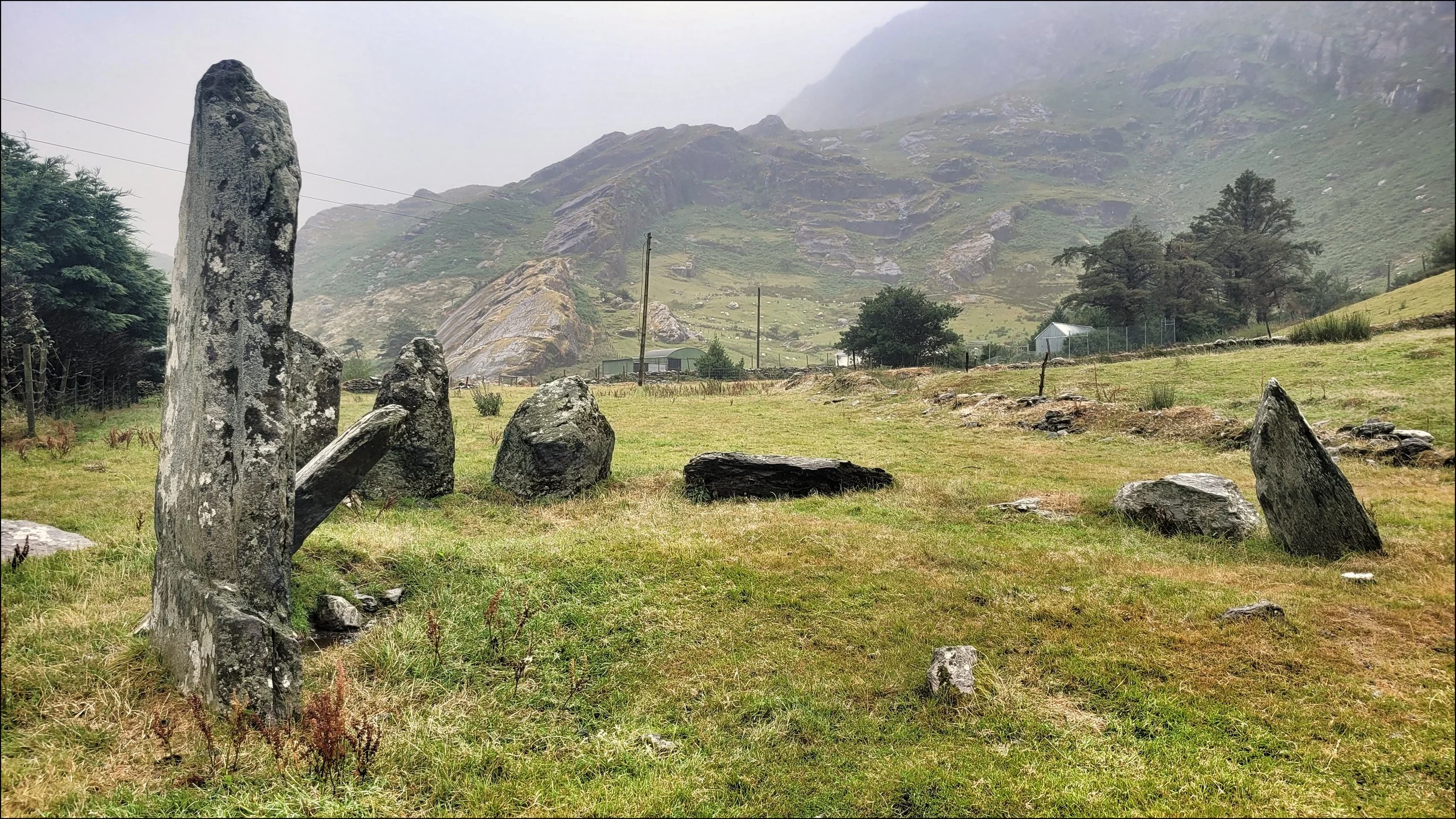
I drove back up to Derreen and found a forest car park for the night. The rain eased off, so I started out on a walk I’d planned for the next day. This should have been a straight hour long loop walk like my first walk that day at Dromagorteen but I had a surprise in store.
The path through the forest was easy to follow at first, but for some reason I veered off it and became surrounded by mossy tree stumps and fallen branches. I then made the mistake of not turning back. I knew that the forest ended up on the ridge ahead and beyond the tree line somewhere was the circle of Cashelkeelty. I ploughed on, scrambling over and under fallen tree trunks with spiky branches into a labyrinth of increasingly impassible obstacles. My progress slowed and feeling like the forest was about to swallow me up I soon realised I could go no further. I had lost an hour and gained a few scratches but found my way back to easier ground.
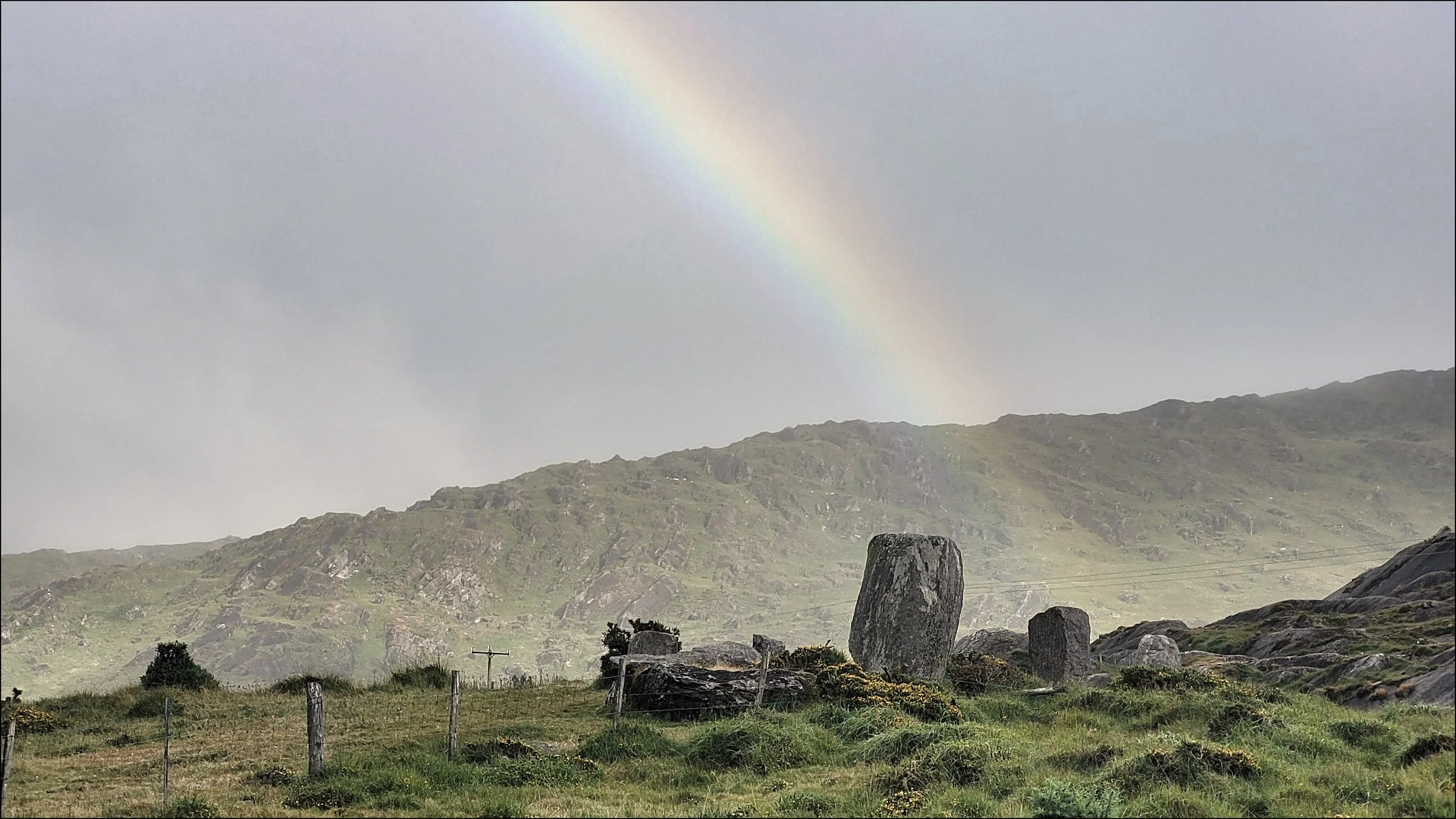
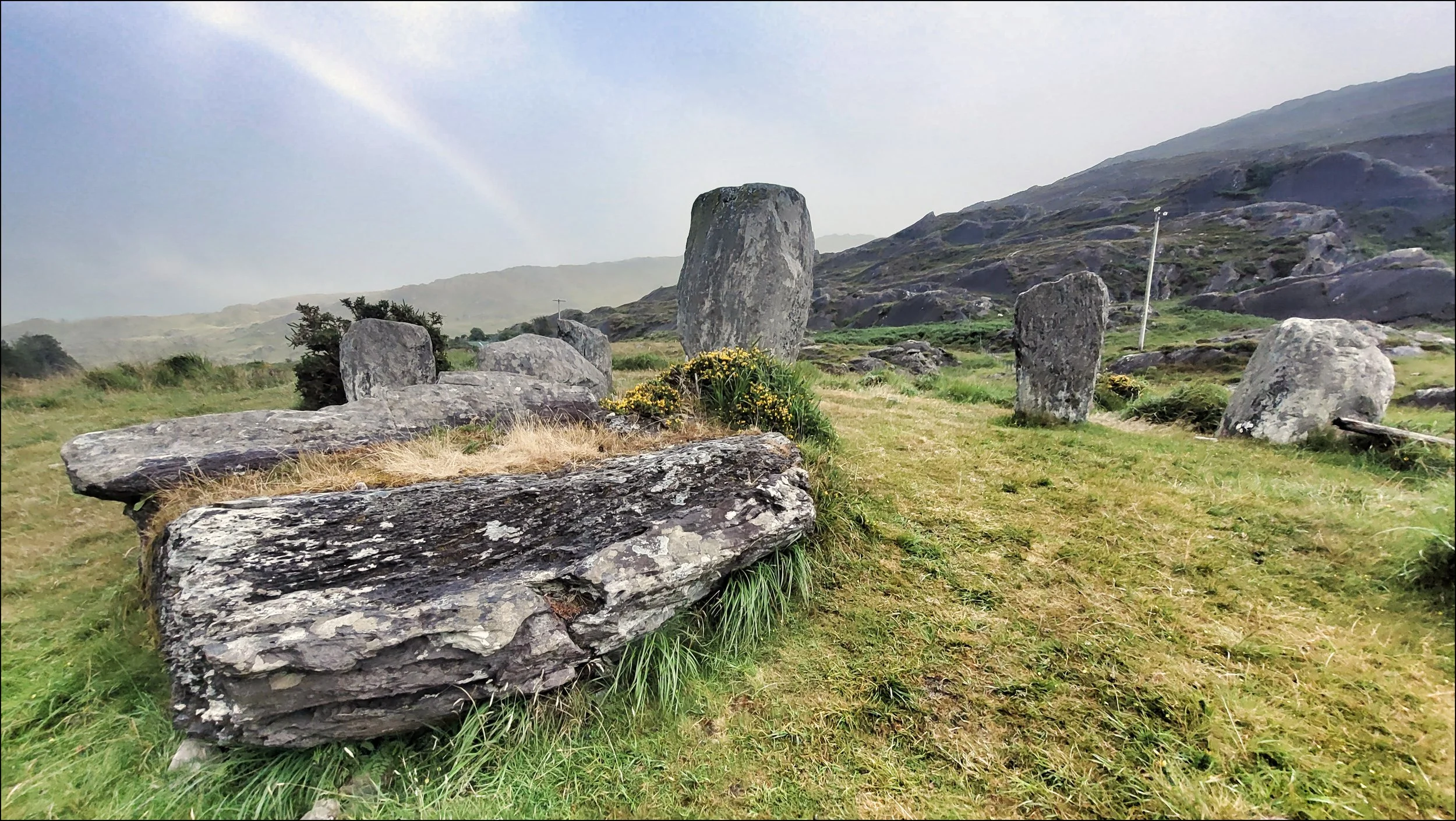
The light was beginning to fade and the mossy forest floor took on an eerie luminous hue. I passed a creepy derelict cottage next to a stream where the only thing missing was a Leprecaun riding a Unicorn. Then with some relief saw the open moorland beyond the crags and ferns. I emerged out into the half light and followed the tree line up to the top corner where unexpectedly three large stones stood in a row. They lined up north east to south west and as I glanced to the east I saw the circle up on a mound with a rainbow forming behind it. On first impression Cashelkeelty was very similar to Uragh, with a dominant large playing card shaped stone adjacent to a tight ring of low stones around a central cist. Here however, the layout was confused by what looked like two broken and fallen portal stones, and the remains of a second circle with only three stones left just to the east. As the rainbow faded away a flock of sheep passed by followed by a farmer on a quad bike. His name was Frank and stopped to chat for a while telling me of a quicker and less troublesome way back down to the car park.